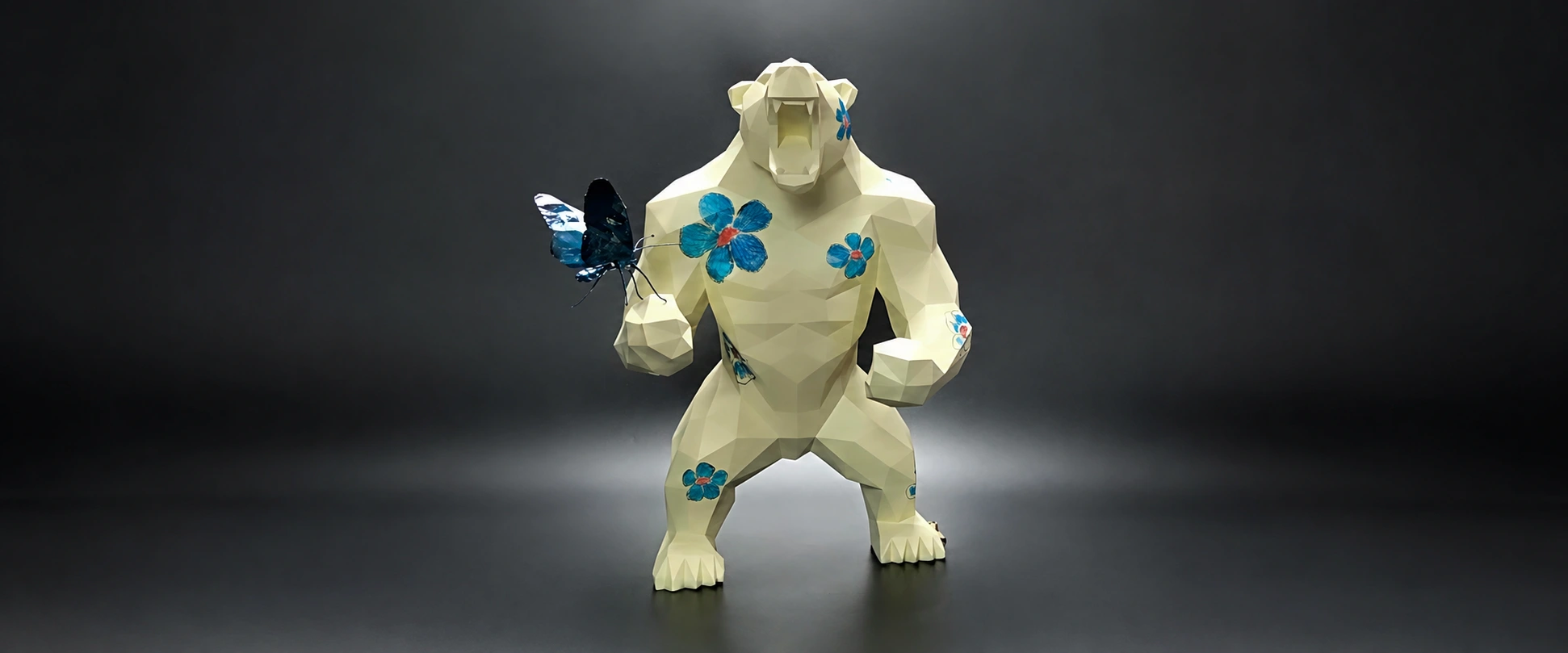
By Spring III, flowers are no longer new to the Young King.
He has already seen them.
He has already drawn them.
Their traces have begun to accumulate upon his body.
But childhood does not move forward by completing one lesson before beginning another.
Attention shifts.
A gesture begins.
Another interrupts it.
Something is finished.
Something else is simply left where the hand stopped.
The First Flower — Spring III is the third seasonal work in The First Flower, the childhood chapter of The Young King Universe created by Vietnamese artist Vo Anh Tuan.
In this work, some flowers are carefully colored.
Three are intentionally left partially colored.
A single leaf appears.
The Butterfly remains close.
And near the Young King's foot, a fragment of the Genesis Shell quietly preserves a physical connection to the origin from which he came.
Spring III does not correct what childhood left unfinished.
It preserves it.
After repetition comes difference
Spring I began with discovery.
Spring II allowed the first experience to continue and develop.
By Spring III, the Young King has begun to acquire a past.
Flowers have appeared before.
The Butterfly has been near before.
Drawing itself is no longer entirely new.
But repetition does not make one moment identical to another.
This time, the flower language changes again.
The flower separates from the stem and calyx.
It becomes a more independent form.
At the same time, the drawings across the Young King's body become more varied in their state of completion.
Some receive attention until their color feels resolved.
Others do not.
The difference is allowed to remain.
Three flowers left partially colored
Three flowers in Spring III are intentionally left partially colored.
This distinction is important.
They are not evidence of an unfinished sculpture.
They are not damage.
They are not areas awaiting later restoration or completion.
The artwork itself is complete.
What remains incomplete is the action recorded within it.
A child may begin drawing and stop.
Perhaps attention moves somewhere else.
Perhaps the hand becomes tired.
Perhaps there is no reason that survives clearly enough to be remembered.
Spring III does not assign one explanation.
The stopping itself is enough.
The marks remain exactly because the moment moved on.
The hand should remain visible
As throughout The First Flower, the drawings are made with wax crayon.
Wax crayon preserves pressure and hesitation in a way that polished paint often removes.
A line can thicken.
Color can escape a boundary.
One area can be dense while another remains thin.
The artist's hand remains physically visible.
In Spring III, this becomes especially important.
To return later and make every flower equally complete would change the event recorded by the sculpture.
It would replace the gesture of childhood with the judgment of an adult looking backward.
The work refuses that correction.
What stopped remains stopped.
A single leaf
Among the flowers appears one small leaf.
Only one.
It is easy to overlook.
That is part of its character.
Spring III does not turn the leaf into a new system that needs immediate explanation.
It is simply another thing that appeared within the Young King's act of drawing.
A flower.
Another flower.
Then, once, a leaf.
Childhood often accumulates details in this way.
Not according to a completed symbolic program.
According to attention.
The Butterfly remains near
The Butterfly is still present.
By now, its nearness carries a different feeling from a first encounter.
It has become part of the Young King's early world.
But Spring III still does not require the Butterfly to explain itself.
It remains beside the King and beside the flowers.
Presence continues before explanation.
That continuity matters because memory is not formed only by objects.
It is also formed by who — or what — was there when a moment happened.
Origin remains at his feet
Near the Young King's foot lies a fragment of the Genesis Shell.
It is a small physical remnant of Origin.
By Spring III, the visual world has changed dramatically from the darkness of Genesis.
There are flowers.
Wax-crayon marks.
Color.
A Butterfly.
The directness of childhood.
Yet Origin has not disappeared simply because the Young King has moved away from it.
A fragment remains.
Not as a source of power.
Not as an explanation of what the Young King should become.
As a trace of where he came from.
This allows two different forms of memory to exist within the same work.
The flowers preserve experiences being created now.
The Genesis Shell preserves something that came before.
The Young King stands between them.
The body has begun to carry time
In Genesis Core III — Primal Form, the Young King's body first became visible.
In Spring I, experience began leaving traces upon that body.
In Spring II, those traces began to form a sequence.
By Spring III, the surface carries differences between moments.
Finished and unfinished.
Careful and hurried.
Present experience and distant origin.
The body is no longer simply a sculptural form.
It has begun to carry time.
This does not mean that every mark needs to become a symbol.
Quite the opposite.
The strength of these traces lies partly in the fact that they can remain ordinary.
A child drew them.
The moment passed.
They stayed.
When the moment moves on
Adults often return to unfinished things.
We correct them.
Complete them.
Make them consistent.
Childhood does not always behave that way.
A child can move from one thing to another without deciding that the previous action was incomplete.
The moment has simply changed.
Spring III preserves this condition.
The three partially colored flowers remain because returning to complete them would create a different moment.
The original gesture would no longer be intact.
This is why incompleteness within the drawing does not make the artwork incomplete.
The artwork is complete precisely because it preserves the event as it occurred.
A memory does not need perfect edges
Memory rarely returns as a perfectly completed image.
Some details remain vivid.
Others disappear.
A color survives.
A shape becomes uncertain.
Something seemingly insignificant remains while something important is forgotten.
Spring III does not attempt to imitate memory literally.
But its unfinished gestures begin to approach the way memory behaves.
What remains is enough to tell us that something happened.
Not everything needs to be recovered.
Not everything needs to be completed.
The absence can belong to the memory too.
Spring has begun to become the past
By the third work, The First Flower is no longer only establishing new experiences.
It has begun to contain earlier ones.
Spring I can now be looked back upon.
Spring II exists between a first encounter and what follows.
Spring III carries those earlier moments forward while adding something neither of them contained.
This is how a sequence becomes history.
Not because every work replaces the one before it,
but because each new moment gives the earlier moments a place in the past.
Spring III therefore carries a quiet change.
The Young King is still inside childhood.
He is still drawing.
The Butterfly is still nearby.
But Spring has already begun to acquire memory.
What was left behind
Some flowers were finished.
Three were not.
One leaf appeared.
The Butterfly stayed near.
The fragment of Origin remained beside him.
Then the moment passed.
No one returned to make all the flowers equal.
No one corrected the lines into something more polished.
No one completed the memory for him.
They were left exactly where the hand had stopped.
And because they were left there,
the moment remained visible.
Spring III does not ask whether every flower was completed.
It asks something quieter:
How much of a moment must remain before it becomes a memory?
For the Young King,
perhaps only a trace was enough.
ARTICLE 008
The Young King Journal
Vo Anh Tuan · The Young King Universe