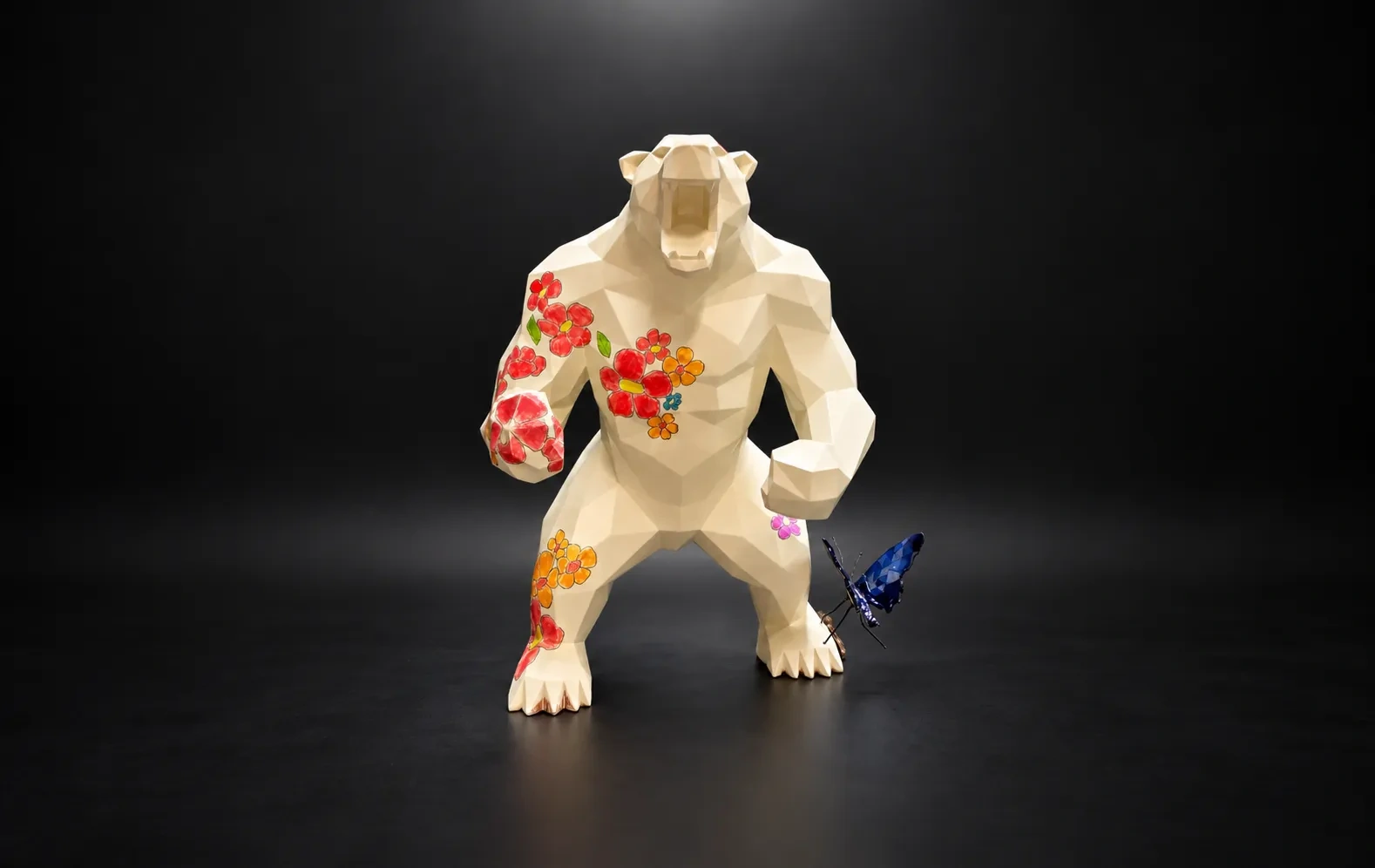
The First Flower — Summer III marks the final movement of Summer within the chronology of the Young King.
The warmth remains.
The flowers remain.
The colour remains.
But something has changed.
After the abundance of Summer II, the flowers no longer gather with the same intensity.
More of the original ivory surface becomes visible again.
The body begins to open.
Summer has not disappeared.
It has begun to let go.
After the Fullness of Summer
Summer I opened the season.
Summer II carried it to its fullest state.
Summer III begins after that point.
The change is gradual.
There is no sudden loss of colour.
No clear boundary announces that one moment has ended and another has begun.
Instead, the balance of the sculpture begins to shift.
The flowers become less concentrated.
The spaces between them become more visible.
The physical body begins to breathe differently.
What was once moving toward abundance is now beginning to release it.
Summer is still present.
But it is no longer expanding.
The Flowers Begin to Open Apart
The visual language remains connected to the works that came before.
The flowers are still simple.
The petals remain imperfect.
The wax crayon remains visible.
Nothing becomes botanical illustration.
Nothing becomes decorative pattern.
But the relationship between the flowers and the body changes.
In Summer II, the flowers gathered into stronger zones of growth.
In Summer III, those zones begin to loosen.
Individual flowers become easier to see.
More space appears between one mark and another.
The change is subtle.
But within The First Flower, it is important.
Growth is no longer expressed only through addition.
For the first time, change is also expressed through release.
The Ivory Surface Returns
As the flowers begin to separate, more of the Young King’s original ivory surface becomes visible.
These areas are not empty.
They are not unfinished.
They are part of the seasonal condition of the work.
The return of the ivory surface allows the sculpture itself to come forward again.
Its mass becomes clearer.
Its faceted form becomes more present.
The marks no longer carry the same visual density as Summer II.
The balance is changing.
Summer III therefore exists between two states:
what remains,
and what is beginning to leave.
The Butterfly Moves
The Blue Butterfly also changes its position.
It is no longer resting high on the body of the Young King.
It has moved downward.
Closer to his feet.
Closer to the Genesis Shell Fragment.
The movement is small.
But the position is not accidental.
The Butterfly looks toward the fragment.
It does not touch it.
It does not reveal anything.
It does not explain.
The Young King still does not understand what the fragment means.
For him, it is simply something that has remained with him from a beginning he cannot remember.
The Butterfly remains silent.
Its role is not to give him an answer before he is ready to understand it.
The Genesis Shell Fragment
The Genesis Shell Fragment belongs to the origin of the Young King.
But origin and understanding are not the same thing.
The fragment can remain beside him long before he knows what it is.
In Summer III, its presence becomes more noticeable through the movement of the Butterfly.
Nothing supernatural occurs.
No hidden power is activated.
No revelation takes place.
The fragment simply remains.
A piece of origin existing quietly inside a life that has not yet learned how to read it.
This distance between having an origin and understanding an origin is part of the Young King’s journey.
For now, the answer stays silent.
A Different Flower
Among the remaining colours of Summer, another colour appears.
Pink-purple.
Only one flower.
It does not dominate the composition.
It does not replace the colours around it.
It appears quietly among them.
For the Young King, it is simply another flower.
He does not yet know what the colour announces.
He sees it.
He remembers it.
And he continues to draw.
The transition therefore begins without explanation.
The next season does not arrive through a declaration.
It first appears as a colour.
The Language Remains Childlike
The flowers continue to be made in wax crayon.
The material remains deliberately unvarnished.
This preserves the directness and physical vulnerability established throughout The First Flower.
The marks may soften.
They may fade.
They may change with time.
That possibility remains part of the work.
The Young King is still a child.
His visual language should not become more sophisticated simply because the chronology is becoming more complex.
He draws what he sees with the means available to him.
Observation comes before interpretation.
Experience comes before explanation.
The material must grow only when he grows.
Summer III therefore retains the same simple language while allowing the meaning around that language to deepen.
The Sculpture Remains Primary
Summer III contains less concentrated colour than Summer II.
But reduction does not mean weakness.
As the seasonal marks begin to loosen, the physical sculpture becomes more visible again.
Its body, posture and faceted geometry continue to carry the work.
The flowers do not replace the sculpture.
They pass through it.
The seasons change.
The marks change.
The relationships between the elements change.
But the Young King remains physically present beneath them all.
This is essential.
The sculpture is not a surface waiting to be decorated.
It is a body passing through time.
Summer Does Not Disappear
Summer III completes the Summer sequence of The First Flower.
But completion does not mean erasure.
The flowers of Summer are still visible.
The warmth has not vanished.
The life that reached its fullest state in Summer II has not been rejected.
It is simply beginning to change form.
The season leaves gradually.
One flower at a time.
One open space at a time.
One small movement of the Butterfly at a time.
Nothing announces the transition loudly.
The Young King does not stand before the world knowing that Summer is ending.
He only notices that things are no longer exactly as they were.
That is enough.
A Moment Between Seasons
Summer III belongs to a precise moment within The First Flower.
It cannot replace Summer I.
It cannot repeat Summer II.
And it cannot yet become Autumn.
It exists between them.
The old season remains visible.
The next season has begun to leave its first trace.
The Young King stands inside that transition without fully understanding it.
This is the condition of Summer III.
Not arrival.
Not disappearance.
Transition.
A moment when one state of the world begins to release another.
And once that balance changes, it cannot return in exactly the same way.
Now Part of The Young King Universe
The First Flower — Summer III is now part of the public chronology of The Young King Universe.
It follows Summer I and Summer II as the third and final work of the Summer sequence within The First Flower.
Summer I marked the threshold.
Summer II marked abundance.
Summer III marks release.
Together, the three works record a complete seasonal movement through the body of the Young King:
the arrival of Summer,
the fullness of Summer,
and the first quiet movement away from it.
The next season has not yet fully arrived.
But its first sign is already here.
A single flower.
A different colour.
And a child who does not yet know what it means.
Artwork by artwork.
Season by season.
Moment by moment.
Stories may return.
Characters may return.
Moments never return.