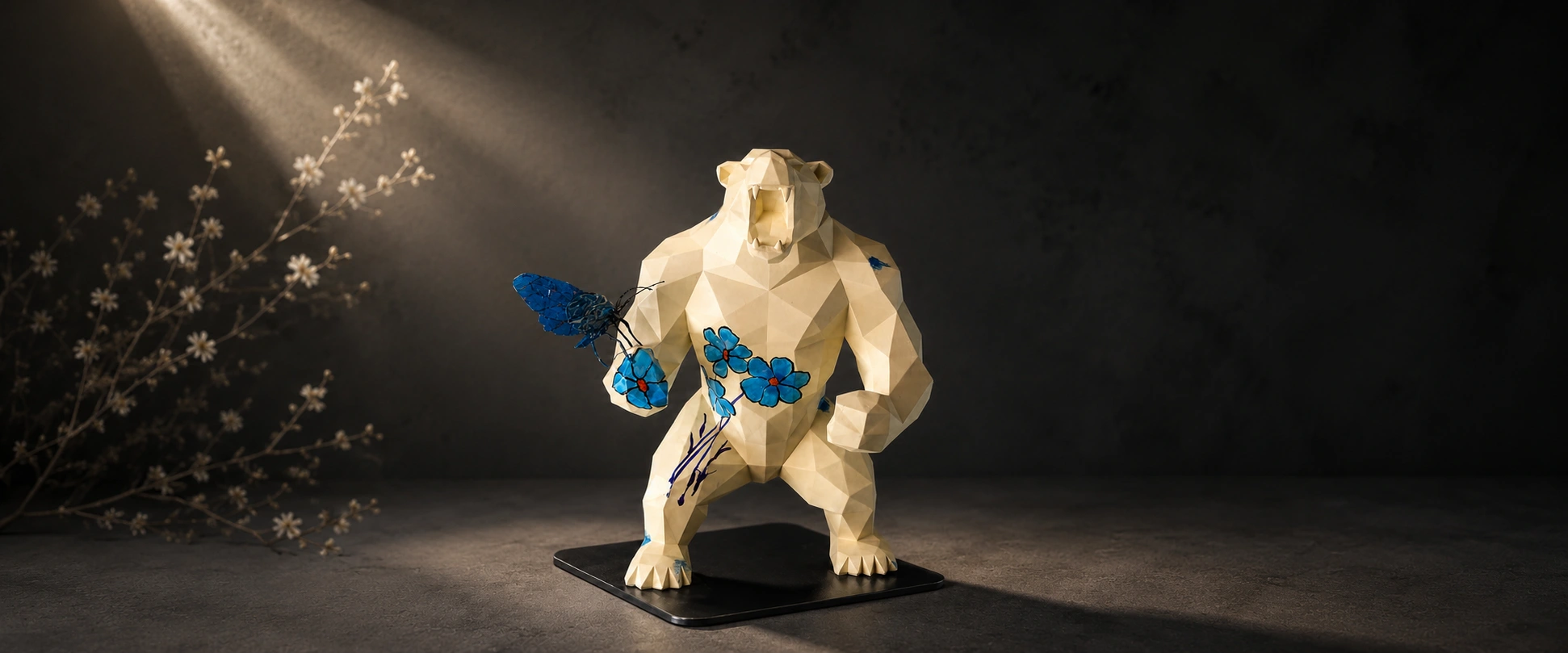
The Young King had entered the world.
Now, for the first time, something in that world began to remain upon him.
The First Flower — Spring I is the first seasonal work in The First Flower, the childhood chapter of The Young King Universe created by Vietnamese artist Vo Anh Tuan.
After the darkness and uncertainty of Genesis, the language of the work changes.
A flower appears.
Then a mark.
And something that once existed only outside the Young King begins to enter his physical memory.
Spring I begins there.
The first encounter
For an adult, a flower can be familiar enough to disappear into the background.
For a child, familiarity has not yet taken control.
Something small can still become the center of the world.
In Spring I, the flower matters not because it is rare, but because the Young King is still capable of seeing it without knowing in advance what it should mean.
He notices.
He looks.
He responds.
The encounter is simple.
Its consequence is not.
Because the flower does not remain only something he has seen.
It begins to leave a trace.
From the flower to the body
The body of the Young King had first appeared in Genesis Core III — Primal Form.
There, the form existed close to its origin.
Spring I begins to change that surface.
Hand-drawn marks appear directly upon the sculpture.
The flower is no longer separated from the figure as an object placed nearby.
It becomes part of the body.
This is one of the first important transformations in The First Flower.
The Young King begins to carry what he encounters.
Not as decoration.
Not as a symbol carefully assigned from outside.
As a physical trace of attention.
The language of wax crayon
The drawings in The First Flower are made with wax crayon.
That choice is essential to the work.
Wax crayon does not hide the gesture that made it.
Pressure changes the line.
Edges remain irregular.
Color can be dense in one place and thin in another.
The hand remains visible.
For Spring I, this imperfection is not something to correct.
It is part of the language.
The marks are allowed to remain direct, childlike and physically present on the sculpture.
They are not refined into conventional painting.
The purpose is not to make the Young King's body more decorative.
The purpose is to allow a moment of childhood to remain visible.
The first flower
The flower language of Spring I retains a simple stem rising from the ground.
It is still close to the idea of a flower as a child might first recognize it:
flower,
stem,
earth.
There is little need for complexity.
This simplicity matters because Spring I is a beginning.
The Young King is not yet building a system of symbols.
He is responding to what he sees.
The flower exists before any explanation of the flower.
And the drawing exists before anyone asks what the drawing is supposed to represent.
The Butterfly stays close
The Butterfly remains one of the earliest presences around the Young King.
Its relationship to him is quiet.
It does not instruct him how to draw.
It does not explain why the flower matters.
It stays near the moment.
That is enough.
Within The Young King Universe, some of the most important relationships begin without dialogue.
Presence comes before interpretation.
The Young King does not need to understand the Butterfly in order to remember that it was there.
Learning to see
Spring I is not about learning the name of a flower.
It is about something earlier.
Attention.
A child begins to build a world by noticing that things exist beyond himself.
A shape.
A color.
A movement.
A living thing.
The act may seem insignificant.
But attention is one of the first ways experience enters memory.
The Young King sees something.
Then, through drawing, he carries part of that encounter with him.
This is why the flower appearing on his body matters.
Seeing has become a trace.
Nothing needs to be polished
The marks in Spring I retain the irregularity of their making.
The line does not need to become perfectly smooth.
The flower does not need to become botanically correct.
The coloring does not need to obey an adult standard of finish.
To correct those things would be to replace one kind of truth with another.
The Young King is not trying to demonstrate skill.
He is responding.
The distinction is fundamental to the visual language of The First Flower.
Childhood is not reconstructed here as nostalgia.
It is preserved through gesture.
The first memory of Spring
A moment becomes memory only after it has passed.
While the Young King is looking at the flower, he does not know that the encounter will belong to his past.
He does not need to.
This is one of the recurring conditions of The Young King Universe:
meaning often arrives later than experience.
Spring I therefore does not need a grand event.
Its significance lies precisely in its smallness.
One encounter.
One response.
One trace left behind.
Over time, more experiences will come.
More marks will appear.
The language of the flowers will change.
But this first moment cannot happen again.
The beginning of a sequence
The First Flower — Spring I is not an isolated image of childhood.
It begins a sequence.
Later works will continue the relationship between the Young King, flowers, drawing and memory.
But Spring I must remain what it was:
the first moment in which seeing became something the Young King could physically carry.
The flower was outside him.
Then he saw it.
Then he drew.
And afterward,
the world was no longer entirely outside.
A small part of it remained on him.
ARTICLE 006
The Young King Journal
Vo Anh Tuan · The Young King Universe