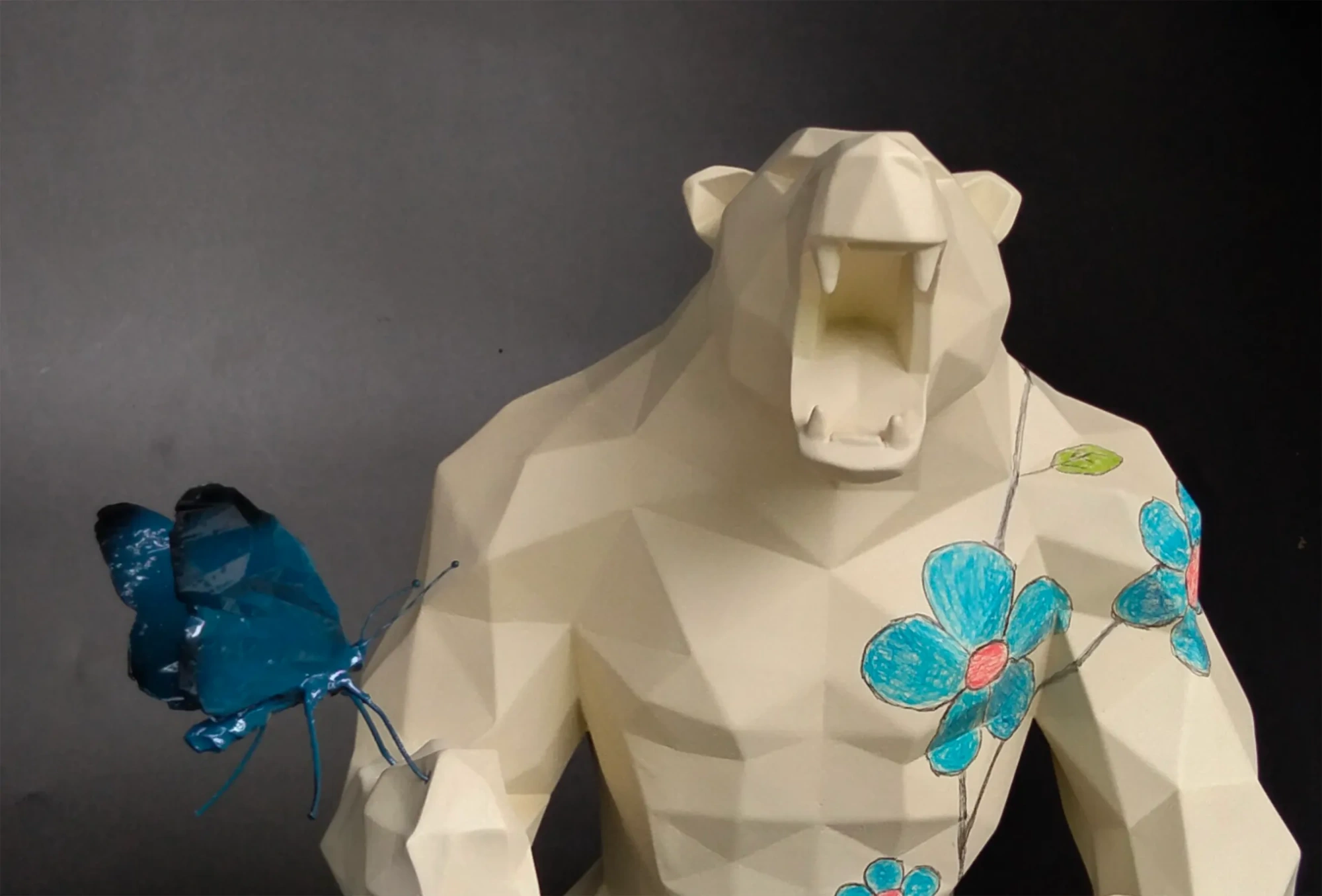
Following The First Flower — Spring I, the work preserves the same childlike language of wax-crayon drawing while allowing the flower itself to begin to change.
In Spring I, the flower appeared in a direct and simple form, rising from a grass-like stem.
In Spring II, that structure becomes more developed.
The flower now grows from a woody branch, introducing a new physical character while retaining the immediacy and innocence of the original drawing language.
The marks remain intentionally simple. They are not illustrations placed upon the sculpture as decoration, but traces of a young experience becoming visible on the body of The Young King.
The wax crayon remains uncoated, preserving the direct material quality of the drawing.
Within the twelve-work sequence of The First Flower, Spring II therefore represents both continuity and change.
The season remains Spring.
The visual language remains childlike.
But the flower has already begun to evolve.
With each work, The Young King carries something forward from what came before — while allowing the world around him to leave a new mark.